
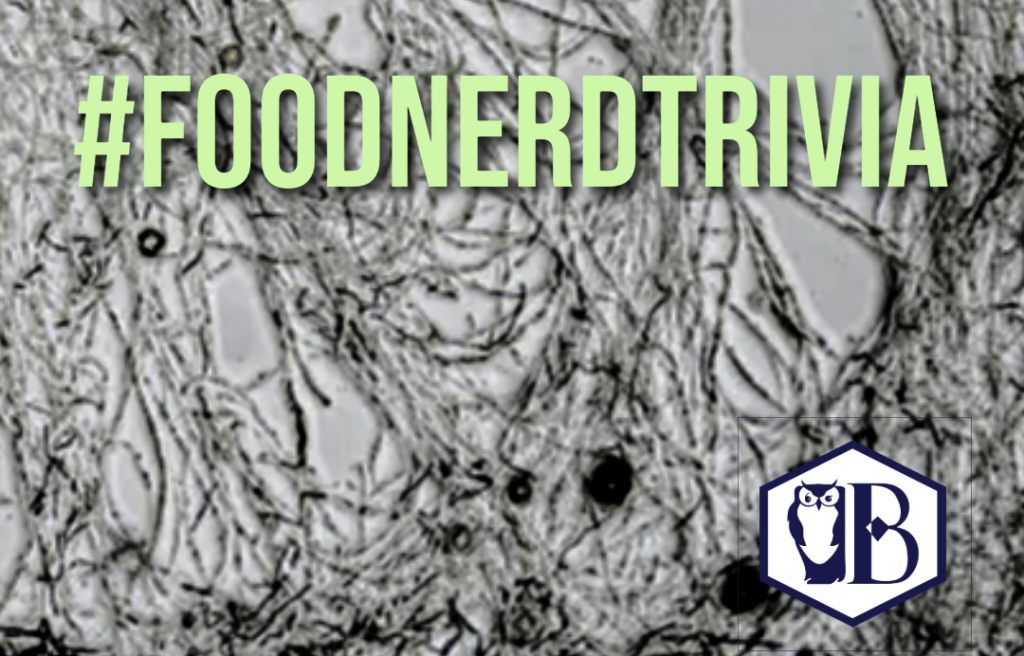
Question: What uses a symbiotic culture of bacteria and yeast and comprises three main types of fermentation: alcoholic, lactic, and acetic?

A: Kombucha
Kombucha is in a moment of viral fame. With some noted health benefits and a tangy natural effervescence, the kombucha fan club is growing rapidly. With many inspired home kombucha brewers out there, let’s spill the tea on what it actually is and any food safety hazards associated with it.
What is it?
Kombucha is tea and SCOBY. It’s as simple as that.
SCOBY stands for Symbiotic Culture of Bacteria and Yeast. Yeah, the acronym sounds better. It is a gelatinous polymeric cellulose pellicle (biofilm) formed by the activity of certain strains of Acetobacter sp., lactic acid bacteria, acetic acid bacteria, and yeast during the fermentation of sweet tea. It’s a mouthful.
It has organic compounds, bioactive peptides, phenolic compounds, Bacillus coagulans, Lactobacillus nagelii, Gluconacetobacter, Gluconobacter, Komagataeibacter species, and more. With yeasts mainly of the Brettanomyces and Cyberlindnera jadinii species.
The paper below found the following species in the nine commercially-available drink samples tested: Bacteroides thetaiotamicron, Escherischia coli, Enterococcus faecalis, Bacteroides fragilis, Enterobacter cloacae complex, and Akkermansia muciniphila.
Here’s a paper on the risks and regulatory framework: Kombucha benefits, risks and regulatory frameworks: A review – ScienceDirect
Microbial and Chemical Profiles of Commercial Kombucha Products – PMC Nutrients. 2022 Feb 5;14(3):670. doi: 10.3390/nu14030670.

Food Safety Hazards
Prevent biological hazards in your Kombucha brew.
Pathogenic growth is inhibited by the fermentation process as it lowers the pH of the liquid from ~5 to 2.5. (If on day 10, the pH is > 2.5, throw out the lot.) Fermentation is complete within 7-10 days. Store Kombucha in the refrigerator.
Kombucha Safety
Implement control steps: boil water, sterilize all surfaces and utensils, and keep hands clean. Also, proper PPE and control area restrictions in commercial processing facilities. At home, it would be… ambitious to wear a beard net, gloves, and clean coat. Shout out to a ‘safety first mindset’ even when no one is looking.
There are no identified allergies, but people may experience a reaction if they have sensitivities to mold, yeast, and fungi. The recommended daily amount of kombucha is 4-8 ounces as it is acidic and too much can cause metabolic acidosis (acidic bloodstream).